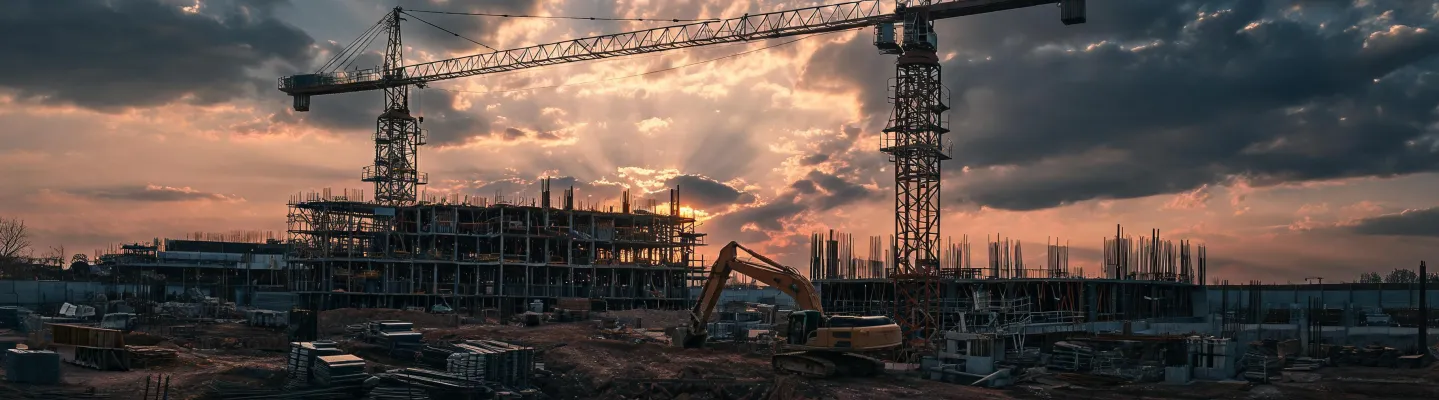
Monday afternoon, 3:47 PM. I remember the time because I'd just sat back down after refilling my water bottle. Our site foreman's name popped up on my phone. The hydraulic pump on our Terex RC 30 terrain crane had started weeping fluid again—worse this time. We had a concrete pour scheduled for Thursday morning. If that crane wasn't operational, we were looking at a $14,000 rescheduling penalty with the GC.
I'm the office administrator for a 42-person general contractor. I handle all our service and parts ordering—roughly $68,000 annually across eight vendors. I report to both our operations manager and our controller. When something breaks in the field, the call comes to me first.
Three days' notice. That's what I had.
Calling Three Vendors in Ninety Minutes
Normally I'd follow our standard procurement process: get three quotes, compare lead times, verify warranty terms, run it past operations. That takes four to five business days minimum. There was no time for that.
I called the three vendors we typically use for Terex crane parts and service.
Vendor one: "We can get you the seal kit, but our minimum order on that SKU is three units. Each one's $240." I didn't need three seal kits. I needed one. Maybe two, if I wanted a spare. I asked if they'd waive the minimum for a first-time order on this specific part. Short answer: no.
Vendor two: "Best lead time I can give you is six to eight weeks." Useless.
Vendor three was an authorized Terex dealer about 40 minutes from our yard. I'd never actually placed an order with them—I'd just had their number in our vendor file from a trade show two years back. A man named Daniel picked up. I explained the situation: RC 30, hydraulic pump leaking, need a seal kit, ideally by Wednesday.
Here's the thing—he didn't immediately quote me. He asked questions. What year was the unit? How many hours on the meter? Was the leak constant or intermittent? Had we replaced the pump before? I didn't know the answers to half of those questions offhand, so I put him on hold, called the foreman, got the details, and called Daniel back.
"Good," he said. "That's the older seal configuration. We stock those. I can have it to you by Tuesday afternoon."
Then came the part I didn't expect.
"How many do you want?"
"Two units," I said. What I meant was two individual seal kits.
What Daniel heard was two complete kits—but in Terex's catalog for that pump, a "kit" includes six individual seals, a gasket, and a set of O-rings. So when the box arrived Tuesday, it had enough components for twelve pumps.
I called him, a little flustered. "Daniel, I think there's been a mix-up. I only needed two."
"Yeah, I figured that out after I hung up," he said. "I almost called you back but I thought—well, if she only needs two, she'll tell me. But I wanted to make sure you had spares. That pump design has a known wear pattern on the shaft seal. If you're replacing one, the other pump on that machine is probably not far behind."
He wasn't wrong. We replaced the seal on the second pump two months later. Having the spares on the shelf saved us another emergency call.
What the Invoice Actually Showed
Daniel charged me for two kits. Not twelve. Not three. Two. And he didn't upcharge for the rush delivery either. The total came to $480 plus tax.
But here's where it gets interesting—the part that made me rethink how I evaluate vendors entirely.
He included a handwritten note with the shipment. It listed the torque specs for the pump housing bolts (which I later verified against our service manual—they matched), the recommended seal lubricant, and a phone number for his direct line. Not the dealership's main line. His cell.
"Call this if you run into anything during install," he wrote. "I'm usually up by 5:30."
Now, I've been doing this job for six years. I've dealt with dozens of vendors. Most of them are fine. They quote you, they ship, they invoice. Transactional. Clean. But this was different, and I couldn't quite figure out why until I talked to our operations manager about it later that week.
"He treated a $480 order like it mattered," she said. "That's rare."
Fast Forward Eighteen Months
We've now ordered from Daniel's dealership—Knox Equipment Solutions, if you're in the Southeast—for every Terex part we've needed since. That includes:
- Replacement wear plates for our Terex jaw crusher parts inventory
- Filters and hydraulic fluid for our third crane, a used Terex T 340 that we bought at auction
- A full set of undercarriage components for our crawler crane—that one was a $6,200 order
I also used their crawler crane catalog when we were evaluating a used HC 110. And when we were writing specs for a new terrain crane specification guide to send out to rental partners, Daniel walked me through the differences between the RC 30 and the newer RT 35 without ever once trying to upsell me.
Between mid-2023 and now, we've done about $22,000 in business with them. Not because they're always the cheapest—they're not. But because I trust that when they quote me a lead time, it'll hold. And when I mess up an order quantity, they'll fix it without making me feel stupid.
"Look, I'm not saying budget options are always bad. I'm saying they're riskier. And in equipment procurement, risk is expensive."
That's what our controller told me when I explained why I wasn't going with the lowest quote on a recent parts order. She agreed.
What I Actually Learned
The lesson isn't "always pay more for better service." That's too simple, and honestly, it's not always true. The lesson is: a vendor's character shows up in the small orders.
When the stakes are low and the profit margin is thin, you see how a company actually operates. Do they cut corners because it's easy? Do they take shortcuts because you won't notice? Or do they do the job right because that's just how they do things?
There's an old OSHA standard (29 CFR 1926.1400) that governs crane safety on construction sites—it requires that all equipment be inspected and maintained according to manufacturer specifications before use. We use that standard to justify our maintenance schedule to ownership. But the practical reality is simpler: a crane that fails is a crane that stops a project. And a stopped project is a very expensive problem.
The vendors who understand that—who treat every order like it matters—are the ones worth keeping.
Daniel's dealership isn't the only vendor we use for Terex. But they're the first call. And that happened because he answered the phone on a Monday afternoon and took a $480 problem seriously.
Not a lecture. Not a sales pitch. Just a man who knew his product and gave a damn about whether our machine ran by Thursday.
That's worth more than a discounted quote.